
CEO DOESN’T WANT HR
Your CEO Doesn’t Want an HR Department — They Want a Growth Engine
Let’s be honest: most CEOs aren’t sitting around dreaming about HR.
They want revenue, growth, performance — and they want every department to play a role in getting there. If you’re leading or working in HR, that might feel like a problem… but it’s actually your biggest opportunity.
At HR Studio, we’ve worked with businesses across South Africa where HR went from being a cost centre to a key driver of business performance. The difference? HR stopped thinking administratively and started acting strategically.
In this article, you’ll learn how to reframe HR’s role in your business, align it with real business goals, and turn your people function into a serious competitive advantage.
What CEOs Actually Want from HR
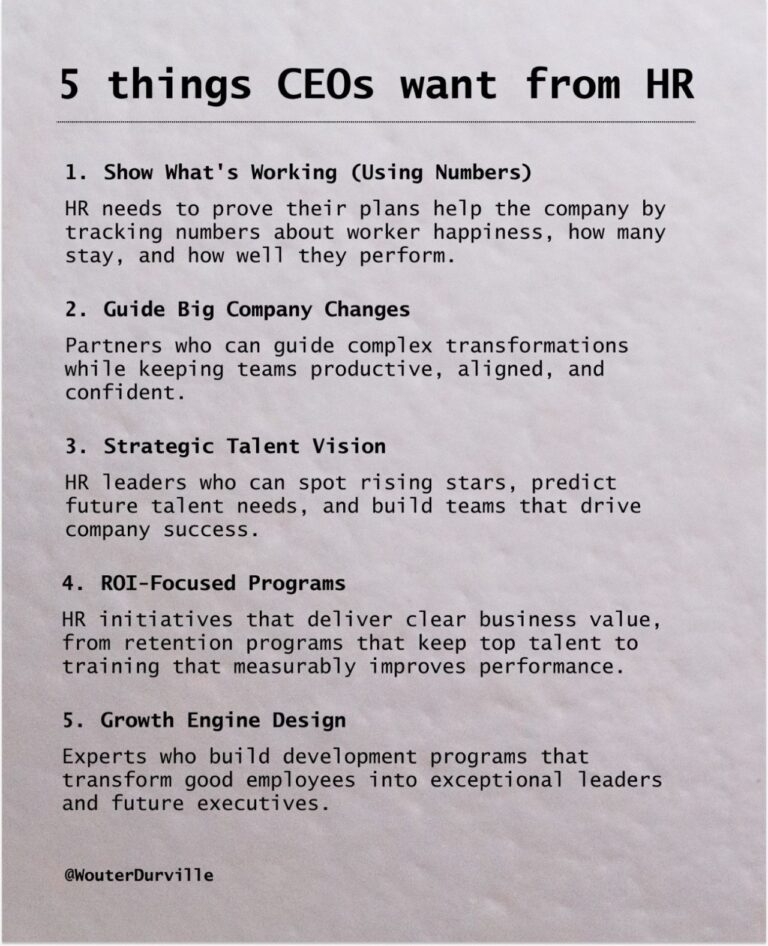
It’s not about job specs and leave tracking (though those things matter). What CEOs really want from HR is:
- A plan to build and retain the right talent
- Less drama and more accountability in teams
- Leaders who can actually lead
- A healthy culture that drives performance
- Metrics that prove people are moving the business forward
They want to know: how are we setting our people up to help the business grow — and what’s HR doing to make that happen?
5 steps
1. Redefine HR’s Purpose
To be seen as a strategic partner, HR has to behave like one.
If your HR function is still focused solely on contracts, compliance and firefighting, it’s going to be seen as administrative support — not a business driver. The shift happens when you reframe HR’s core purpose:
From: Managing processes and people problems
To: Accelerating performance through people
That means getting closer to the business — understanding how it makes money, where the growth opportunities are, and what talent is needed to support that.
2. Align HR Initiatives with Business Goals
Align HR Initiatives with Business Goals
- What are our strategic goals this year?
- What people-related challenges might stop us getting there?
- How can HR help solve those challenges?
For example:
- If your goal is expansion, HR should be focused on scalable hiring processes and talent mapping.
- If your goal is retention, HR should be rolling out engagement surveys, analysing data, and fixing culture gaps.
- If your goal is operational efficiency, HR should be improving performance management and manager capability.
3. Use Data to Prove Your Value
If you want to be taken seriously in the boardroom, you need to speak the language of numbers.
Track what matters. That could include:
- Turnover and retention rates
- Time to hire
- Cost of hire
- Absenteeism
- Employee engagement
- Performance ratings
- Training ROI
Don’t just report on data — use it to drive decisions. For example:
“We saw a 22% drop in turnover after rolling out our leadership development programme. That saved us approximately R150k in rehiring and retraining costs.”
That’s the kind of HR input a CEO wants to hear.
4. Focus on Leadership and Talent Development
If your managers are struggling, your teams are struggling.
One of the fastest ways HR can drive business results is by levelling up leadership capability.
That means:
- Training managers to handle tough conversations
- Coaching leaders on how to motivate and retain talent
- Equipping new managers with the basics of good people leadership
Strong leadership reduces turnover, boosts engagement, and creates a ripple effect across the business. And that’s a tangible result any CEO will back.
5. Embed a Culture That Drives Performance
Culture isn’t fluff. It’s how work gets done. And it directly impacts performance.
HR should be shaping and reinforcing a culture that reflects the business’s ambitions — not just managing perks or running once-a-year surveys.
That means:
- Making values part of daily decision-making
- Holding leaders accountable to behavioural standards
- Addressing toxic behaviours early
- Recognising and rewarding high performer
The right culture doesn’t just feel good — it performs.
But What If…?
“Our HR team isn’t strategic enough.”
Then invest in their development. Bring in support. You can’t expect strategic results from a team that’s only been trained for admin.
“We don’t have time to overhaul everything.”
You don’t need to. Start by aligning one key HR initiative to a business goal. Build from there.
“HR still has to do admin — we can’t ignore it.”
Of course. Admin keeps the wheels turning. But strategy drives the direction. Both matter — but don’t let the admin swallow the strategy.
Final Thoughts:
Your People Strategy Is Your Business Strategy
In today’s world, talent is one of the few real differentiators. If your HR team can help you attract, grow and keep the right people — while creating the conditions for them to perform — that’s not a support function.
That’s a growth engine.
If you want to reposition HR as a strategic force in your business, HR Studio can help. From building capability to aligning people strategy with business goals, we partner with SMMEs who are ready to scale — without sacrificing their culture.
CEO DOESN’T WANT HR Read More »
